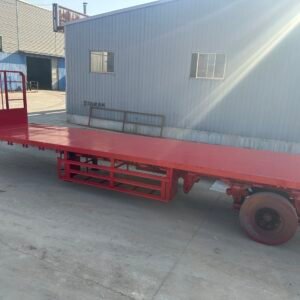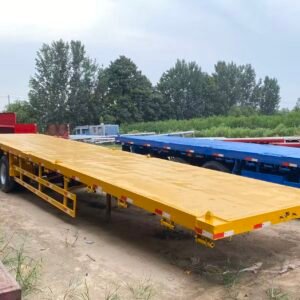
Flatbed Semi Trailer For Sale — 40ft Container & Heavy Cargo
A flatbed semi trailer is the most common trailer on the road, and for good reason. No walls, no roof — just a flat platform on wheels that hauls containers, steel, timber, machinery, building materials and just about anything else you can strap down. If you move freight between a port and a warehouse, or run long-haul cargo in bulk, this is usually the first trailer a fleet buys.
At ENXIN Semi Trailer Factory in Liangshan, Shandong — one of China’s recognized semi-trailer manufacturing bases — we offer flatbed semi trailers for sale in 2, 3 and 4 axle versions, in 20ft, 40ft, 48ft and 53ft lengths. Frames are built from Q345B high-tensile steel, bodies are matched to your local road regulations, and every unit ships with a 12-month warranty.
This page covers the specs, the options and the questions buyers ask us most. If you already know what you need, jump to the quote form — we answer within 10 minutes during working hours.
What a flatbed semi trailer is used for
Container transport is the flatbed’s home turf. The platform is fitted with twist locks at the corners, so a 20ft or 40ft container drops on, locks in and travels. That is why flatbeds dominate port-to-warehouse routes: the container never needs to be unloaded, the whole box moves with the trailer.
Outside containers, the flatbed carries bulk cargo that does not need walls:
- Steel and construction: pipes, coils, rebar, timber, granite slabs, prefab materials
- Machinery: agricultural equipment, industrial machines, vehicles on chains
- General freight: palletized goods, building materials, anything that straps down
Add removable side boards and a flatbed becomes a semi-open cargo trailer. Add tarpaulin arches and it hauls grain and weather-sensitive goods. The platform is a base you build on — that flexibility is why fleets buy flatbeds first.
Typical users: logistics companies moving containers between ports, rail yards and inland warehouses; construction suppliers moving steel and materials; machinery dealers moving equipment between sites; farmers and traders with side boards or tarps.
Flatbed types by axle count
Axle count comes first — it sets the legal payload in most countries.
2 axle flatbed: the lightest and most economical option. Best for 20ft containers and loads up to around 25–30 tonnes. Nimble, low rolling resistance, a common choice for urban and light regional work.
3 axle flatbed: the workhorse, and the model we ship most. The standard choice for 40ft containers and general heavy cargo, with 60–80 tonnes payload capacity. It matches the legal limits in most African, Middle Eastern and Central Asian markets.
4 axle flatbed: for heavy concentrated loads and high-volume routes where local law allows a fourth axle. More wheels, more braking surface, a higher payload ceiling.
After the axle count you choose length. 20ft and 40ft are the container standards; 48ft and 53ft serve North American and long-haul markets.
Specifications — 3 axle 40ft flatbed
Every flatbed we build is tailored to the buyer’s regulations, but this is our standard 3-axle 40ft build:
| Item | Standard Spec |
|---|---|
| Overall length | 12,500 mm (40ft); 6,300 mm (20ft) |
| Overall width | 2,500 mm |
| Deck height | Around 1,500 mm (adjustable) |
| Payload | 60 – 80 tonnes |
| Axles | 3 × 13T (FUWA / BPW / JOST options) |
| Suspension | Heavy-duty mechanical, bogie or air |
| Tires | 12 units, 12R22.5 vacuum |
| Kingpin | 50# or 90# (JOST or equivalent) |
| Landing gear | JOST or equivalent |
| Brake system | WABCO air brake; ABS / disc brake optional |
| Electrical | 24V, LED lights |
| Container fixing | 12 twist locks |
| Main beam steel | Q345B high-tensile steel (T700 option) |
| Warranty | 12 months on main structural components |
One honest note: axle load limits differ from country to country, and we adjust deck height, axle spacing and suspension to your regulations before production. Send us your working conditions and destination port — we will spec the trailer to match, not the other way around.
Configuration options that actually matter
Flatbeds look alike from a distance; they do not behave alike. These are the choices that change how the trailer earns money:
Axles. BPW and FUWA are the two brands we fit most. BPW for European-standard long-haul work, FUWA for proven value in heavy-duty conditions. Both are genuine factory units with supplier warranty.
Suspension. Mechanical leaf spring is the reliable, low-maintenance default — it goes on more than 80% of the trailers we build. Air suspension rides smoother, protects fragile cargo and extends tire life; it is the standard choice for container and precision-cargo operators.
Brakes. Drum brakes are the economical default. Disc brakes shorten stopping distance and handle heat better on mountain routes. ABS is available for markets that require it.
Tires. 12R22.5 vacuum tires as standard, brand per your preference.
Kingpin and landing gear. JOST as standard, 50# or 90# to match your tractor.
Extras. Removable side boards, tarpaulin arches, coil well, tool box, spare wheel carrier, custom paint and your own logo.
Steel and manufacturing: where cheap flatbeds fail
The frame is the part you cannot see in a photo, and it is the part that decides whether the trailer lasts 5 years or 15. Our main beams are Q345B high-tensile steel — roughly 50% stronger than ordinary structural steel (Q235). For buyers running maximum payloads we also offer T700 high-strength plate, which allows lighter construction without losing strength.
Why does the steel grade matter? A trailer frame flexes on every trip, loaded and empty. Higher-grade steel resists fatigue cracks for years longer, and that is the real source of a long service life. We wrote a full comparison of Q345B vs ordinary steel if you want the details.
The beams are welded with automatic submerged arc welding machines — consistent, full-penetration welds, not hand welds with gaps. After welding, every frame goes through sandblasting and electrophoretic primer before painting, so the corrosion protection sits on the metal itself, not just on the top coat.
Quality checks and warranty
Every flatbed we ship passes a pre-delivery inspection: electrical system, air system, braking system, axle alignment and load testing. ISO and CCC certificates are available on request.
Warranty: 12 months on main structural components. Axles, tires and suspension carry the original supplier warranty. For container-loading orders we include free spare parts. Technical support stays available after the warranty ends — most of our customers are still in WhatsApp contact with us years after delivery.
Shipping and delivery
Delivery usually takes 30–60 days from order confirmation, depending on configuration and the production queue. Sea freight is the standard route. Before loading, every trailer is wax-coated and wrapped in tarpaulin to survive the crossing — salt spray is hard on paint, and we plan for it.
We handle FOB and CIF arrangements and provide the full export document set: commercial invoice, packing list, bill of lading, certificate of origin. Tell us your destination port and target date when you ask for a quote — we will tell you honestly whether the timeline works.
Flatbed customers we have shipped to
Most of our flatbed orders go to Africa, the Middle East and Central Asia. The pattern is nearly always the same: a buyer starts with one trailer, runs it for a few months, then comes back for more.
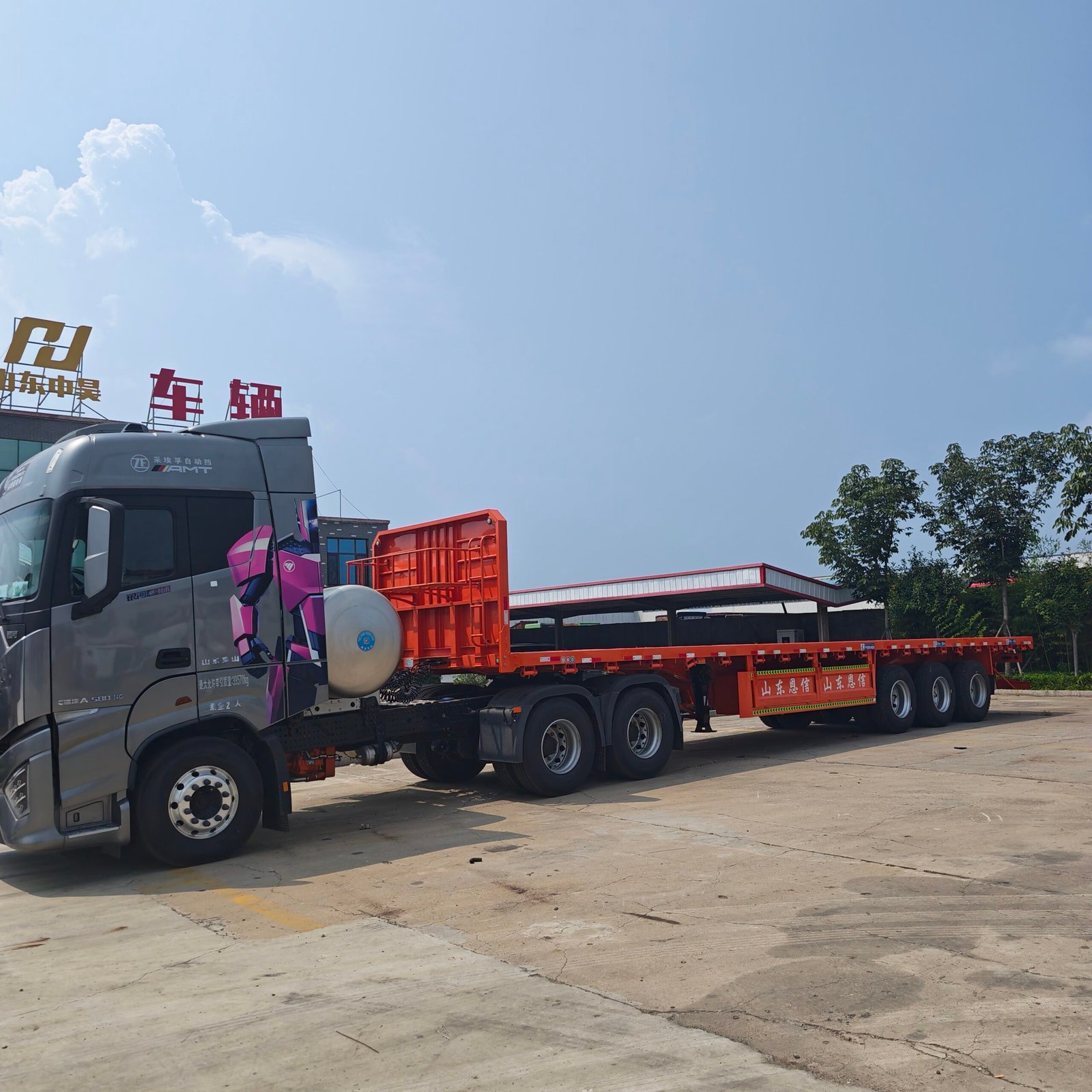
A customer in Burundi took delivery of new flatbed trailers in mid-2026 and praised the build quality in follow-up communication. Our tri-axle flatbed has also been featured straight from the factory yard, showing the finished frame, paintwork and deck details buyers ask about most.
Buyers from Sri Lanka, Senegal, Tunisia, Nigeria, Libya, Colombia, Ghana, Kazakhstan, Oman and the UAE have all visited our factory in Liangshan before ordering. If you are passing through China — for a trade show, an inspection, or a visit — the door is open. Seeing the production line in person answers more questions than a month of WhatsApp messages.
How a flatbed is built at our factory
Here is the production flow, from drawing to port:
- Drawing. Engineers prepare the drawing from your requirements and your local road rules.
- Cutting. CNC plasma cutting shapes the main beams and plates.
- Welding. Automatic submerged arc welding assembles the frame.
- Surface. Sandblasting, electrophoretic primer, paint, wax.
- Assembly. Axles, suspension, tires, landing gear, brake system, lights.
- Inspection. Full test of air, brake and electrical systems; axle alignment and load test.
- Packing. Wax coating and tarpaulin wrap for sea freight.
We send photo and video progress updates at every stage of your own order, so you are never wondering what is happening at the factory.
Flatbed semi trailer FAQ
How much weight can a flatbed semi trailer carry?
A 3-axle flatbed in our builds carries 60–80 tonnes; 4-axle versions go higher. The legal payload depends on your country’s axle load limits, which is why we confirm your local regulations before finalizing the spec.
Can it carry a 40ft container?
Yes. The 40ft flatbed comes with 12 twist locks that fix the container at the corners, and it handles 20ft containers the same way. This is the standard configuration for port and logistics operators.
Flatbed or lowbed — which do I need?
Flatbed: general cargo and containers, deck height around 1.5 m, easy loading from any side. Lowbed: tall heavy equipment like excavators and machinery, with a much lower deck. If your cargo is taller than about 3 m, you want a lowbed. If it is containers or general freight, a flatbed is the right tool.
How long does delivery take?
30–60 days depending on configuration and your destination port. Production progress photos are sent throughout.
What payment terms do you accept?
T/T (30% deposit, balance before shipment), L/C and Western Union. Payment method is agreed before production starts.
How do I know the steel is really Q345B/T700?
Ask for the mill certificate for each production batch. We provide it with every order — a factory that hesitates on this is telling you something.
Can you build to my country’s regulations?
Yes. Dimension limits, axle loads, lighting rules and braking requirements vary by market, and we build to them. Send us your requirements and destination port with your inquiry.
Related trailers
Not sure a flatbed is what you need? Compare it with the rest of our range:
- 3 Axle 40ft Flatbed Semi Trailer — the specific model most buyers order
- Dump Semi Trailer — for sand, gravel, mining and construction waste
- Lowbed Semi Trailer — for excavators and heavy machinery
- Side Dump Semi Trailer — fast unloading for mining and bulk operations
Request the full spec of our flatbed semi trailers — steel grades, axle options and dimension drawings matched to your local road regulations. Message us on WhatsApp for a fast quote, or use the form below and we will come back to you within 10 minutes during working hours.